Wildlife Corridors: The Infrastructure Investment That Pays for Itself
When governments announce a new highway, debate centers on construction costs, completion timelines, and projected economic growth. Success is measured at the ribbon-cutting ceremony, not across the decades that follow. A more consequential question goes largely unasked: what does a road actually cost over fifty years?
The answer extends far beyond asphalt and concrete. Highways fragment habitats, sever migration routes, increase wildlife collisions, and erode the ecological connectivity that sustains biodiversity. These costs surface gradually, through insurance claims, emergency response, medical care, vehicle damage, declining tourism, and degraded ecosystem services. Distributed across systems rather than concentrated in a single budget line, they remain structurally invisible while still accruing to the public that ultimately pays them.
Wildlife corridors expose this accounting failure. They reveal that many roads are not inexpensive projects but underpriced liabilities, their true expense displaced onto environmental and social systems that absorb the difference. The central question shifts accordingly. Whether society can afford wildlife corridors matters less than whether it can afford roads built without them.
Healthy ecosystems operate through connectivity rather than isolation. Forests, rivers, wetlands, and grasslands function as integrated networks through which water, nutrients, species, and genetic diversity circulate continuously. Wildlife movement is not incidental to this system; it is foundational to ecological stability. A road interrupts those flows, converting continuous landscapes into fragmented patches with diminished resilience.
To an engineer, a highway represents connectivity between towns. To a migrating elk, elephant, turtle, or salamander, it is often an impassable barrier. Fragmented habitats reduce breeding opportunities, isolate populations, and accelerate local extinctions. Over time, ecological fragmentation becomes economic vulnerability, as the services those ecosystems once provided quietly decline.
Wildlife-vehicle collisions illustrate the scale of this externalized cost with unusual clarity. In the United States alone, between one and two million such collisions occur every year, contributing to roughly 200 human fatalities, 26,000 injuries, and more than eight billion dollars in property damage annually. Factoring in medical care, emergency response, insurance payouts, legal costs, and lost productivity, the aggregate burden on society exceeds ten billion dollars a year. Large mammals such as deer, elk, and moose account for some of the most severe individual losses, while smaller species suffer even greater mortality at a scale that undermines biodiversity and disrupts pollination, food webs, and agricultural stability.
These outcomes are not unavoidable accidents. They are design failures, and proven interventions already exist. Wildlife overpasses, underpasses, tunnels, fencing systems, and escape ramps have reduced collisions by as much as 80 to 97 percent in well-designed corridors, particularly where crossings are paired with appropriate fencing. Case studies from Banff National Park in Canada and along Highway 191 in Wyoming demonstrate that structural separation between wildlife movement and vehicle traffic produces consistent, measurable results.
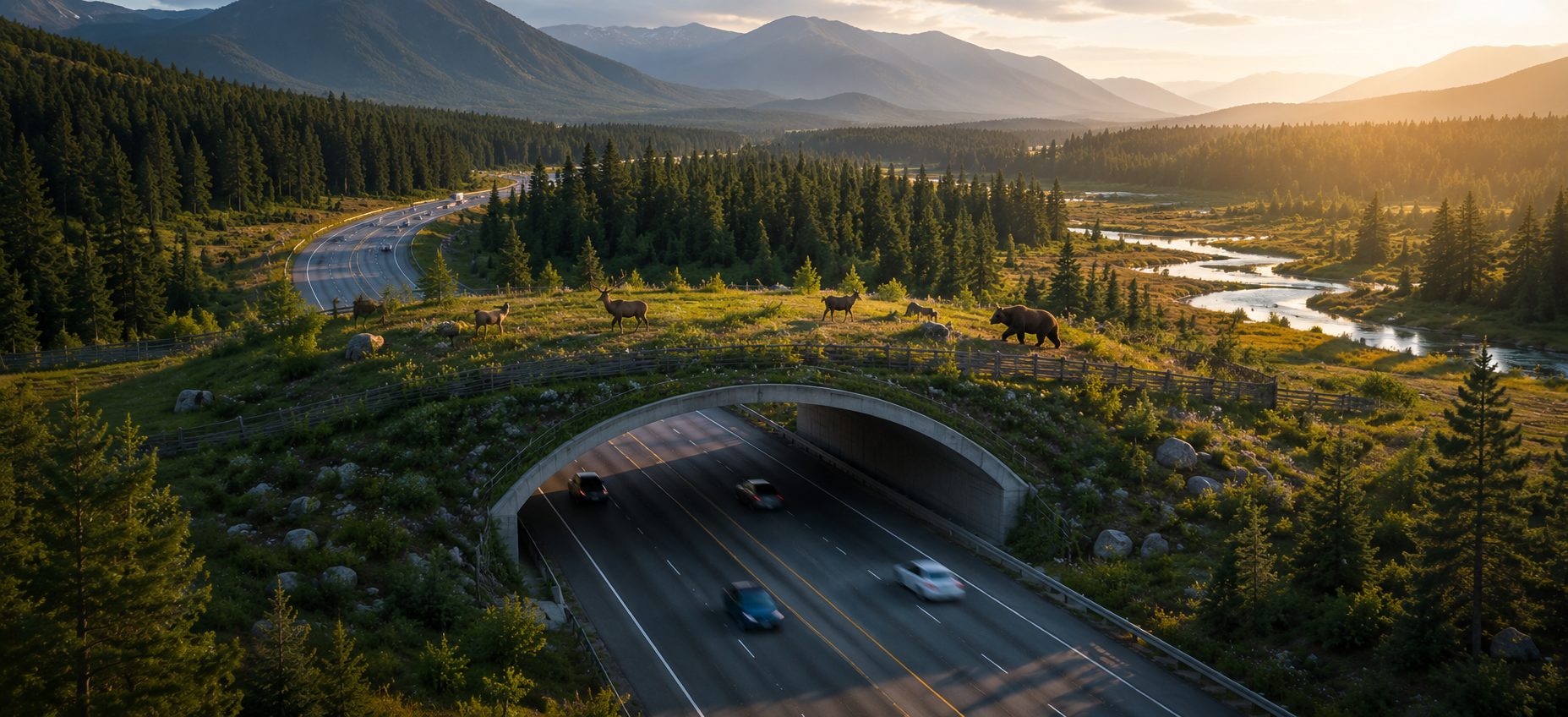
What is both inclusive and financially logical is often what we fail to do.
See content credentials
What is both inclusive and financially logical is often what we fail to do.
The financial logic is stark when broken down by species. The average cost of a deer collision now exceeds $19,000; an elk collision runs approximately $73,000; a moose collision surpasses $110,000 once vehicle damage, medical treatment, and insurance claims are tallied. Researchers estimate that a single well-placed wildlife crossing can prevent roughly 1,400 collisions over a seventy-year lifespan, generating savings that surpass its construction cost many times over.
Insurance systems absorb a significant share of this burden, translating ecological fragmentation directly into actuarial risk. Every avoided collision means fewer vehicle repair claims, fewer bodily injury claims, fewer total losses, and reduced legal and emergency medical expense. In effect, a wildlife crossing converts a dangerous stretch of road into a lower-risk asset. Wildlife corridors function as risk-mitigation infrastructure in much the same way that levees reduce flood losses or sprinkler systems reduce fire losses, lowering liability exposure and stabilizing premiums across the system.
Ecological connectivity also functions as economic infrastructure in a broader sense. Healthy ecosystems regulate water systems, store carbon, pollinate crops, disperse seeds, support fisheries, and stabilize climate conditions. These services underpin agriculture, tourism, and regional productivity, and their gradual degradation produces losses that rarely appear in any infrastructure ledger.
The Serengeti illustrates this dynamic with particular force. Millions of visitors travel there each year for one of the world's last great wildlife migrations, a phenomenon that sustains guides, lodges, restaurants, transport providers, and thousands of local livelihoods. The original route proposed for the Serengeti Highway would have crossed this migration directly, threatening millions of wildebeest and zebra and placing decades of tourism revenue at risk for short-term convenience. The alternative alignment that was ultimately pursued bypassed the critical corridor, improved access for rural communities, reduced construction costs, and preserved one of Tanzania's most valuable economic assets. It was not a compromise between development and conservation. It was simply better development.
The conventional definition of infrastructure treats nature as a passive backdrop against which development occurs. In reality, ecological systems perform infrastructural functions of their own: regulating floods, maintaining soil fertility, stabilizing climate, and sustaining the agricultural productivity that regional economies depend on. Infrastructure that damages these systems weakens the very foundation it stands on.
A road that fragments an ecosystem functions much like a bridge missing critical spans, or an electrical grid with severed transmission lines. The structure remains visible, yet it has lost its integrity. Effective infrastructure strengthens the systems it depends upon rather than degrading them.
Stakeholder incentives increasingly point in the same direction. Governments face rising public expenditure from collision response, healthcare, and repair. Insurers face escalating claims risk. Businesses confront supply chain vulnerabilities tied to ecological degradation and climate instability. Each of these costs originates in fragmented design choices made decades earlier, and each could have been avoided through better planning at the outset.
Indigenous and local communities offer insight that technical planning processes often miss entirely. Generations of observation of migration patterns, seasonal hydrology, and landscape behavior provide a granular understanding that complements satellite imagery and survey data. Incorporating this knowledge is not merely a gesture toward inclusion; it produces measurably better infrastructure.
Every transportation project produces two financial realities. The first reflects construction expenditure, the figure that appears in press releases and budget approvals. The second reflects decades of operational consequences: maintenance costs, accident burdens, ecological degradation, and the slow erosion of ecosystem services. Conventional accounting fixates on the first while neglecting the second entirely. A complete evaluation requires both.
This marks a fundamental distinction between extractive and regenerative infrastructure. Extractive systems prioritize minimizing upfront construction expense while exporting their costs into the future. Regenerative systems prioritize lifetime value, measuring success through durability, resilience, and performance across decades rather than at the moment of completion. Wildlife corridors belong unmistakably to the latter category.
Roads designed with ecological connectivity in mind reduce collisions, save lives, protect biodiversity, preserve tourism revenue, and sustain the ecosystem services that regional economies quietly rely on. Their value compounds with time rather than depreciating the moment construction ends. Roads that ignore connectivity eventually pay for that omission, through fragmented landscapes, rising insurance costs, mounting emergency demand, and diminished natural capital.
The decisive question is no longer whether society can afford to include wildlife corridors. It is whether infrastructure that excludes them can be called affordable at all. A road built with connectivity in mind becomes an appreciating public asset. A road built without it becomes a liability quietly embedded in the landscape it was meant to serve.
See content credentials
Plan holistically, execute inclusively.
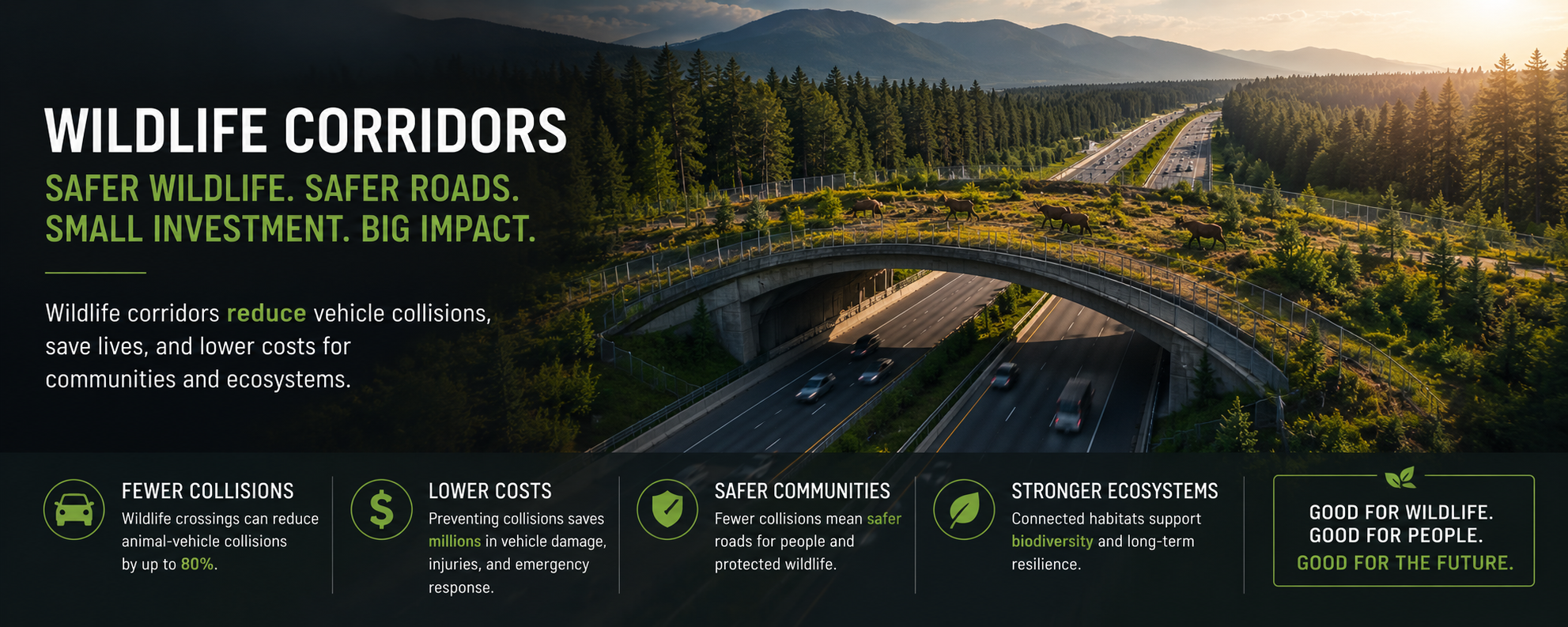
Plan holistically, execute inclusively.
SOURCES
[1] Right of way: race, class, and the silent epidemic of pedestrian deaths in America: by Angie Schmitt, Washington, Island Press, 2020, 248 pages, $25 (paperback), ISBN-13: 978-1642830835
[2] m Complete Streets: Best Policy and Implementation Practices (PAS Report 559); copyright March 2010 by the American Planning Association
[3] America is Telling Itself a Lie About Roadkill, by Ben Goldfarb, Sept 7th 2023, Science, The Atlantic.
[4] Huijser, Marcel & Duffield, John & Clevenger, Anthony & Ament, Robert & McGowen, Pat. (2009). Cost–Benefit Analyses of Mitigation Measures Aimed at Reducing Collisions with Large Ungulates in the United States and Canada: A Decision Support Tool. Ecology and Society. 14. 10.5751/ES-03000-140215.
[5] World Wildlife Magazine, Wildlife crossings help avoid roadway collisions, Fall 2023 https://www.worldwildlife.org/magazine/issues/fall-2023/articles/wildlife-crossings-help-avoid-roadway-collisions
[6] Bridging the gap: How the U.S. is starting to address wildlife-vehicle collisions by Courtney Cole. May 14 2024, Smart Growth America.
[7] Conservation and economic benefits of a road around the Serengeti, J. Grant C. Hopcraft, Simon A. R. Mduma, Markus Borner,∗ Gerald Bigurube, Alain Kijazi,§ Daniel T. Haydon, William Wakilema,§ Dennis Rentsch, A.R.E. Sinclair, Andrew Dobson, and James Daudi Lembeli February 10, 2014.
[8] The Conversation (2021): Africa’s growing debt problem: how it happened and what to do about it https://theconversation.com/africas-growing-debt-problem-how-it-happened-and-what-to-do-about-it-165460
[9] The Conversation, African Countries are Struggling With High Debt Demands to Spend More and Collapsing Currencies the Policy Fixes that Could Help, Jan 31 2024, Jonathan Munemo, Professor of Economics, Salisbury University, https://theconversation.com/african-countries-are-struggling-with-high-debt-demands-to-spend-more-and-collapsing-currencies-the-policy-fixes-that-could-help-221614
[10] Global Financial Integrity, Illicit Financial Flows From Developing Nations Report https://www.gfintegrity.org/wp-content/uploads/2014/12/Illicit-Financial-Flows-from-Developing-Countries-2003-2012.pdf From the Executive Summary: That means that for every single one of those US$89.7 billion in development aid that entered these developing countries in 2012, over US$10 in illicit financial flows (IFFs) came out.
[11] Honest Accounts 2017 - How the world profits from Africa’s wealth, by Mark Curtis , Tim Jones, Jun 6 2017, https://www.cadtm.org/Honest-Accounts-2017-How-the-world
[12] Understanding China’s Belt and Road infrastructure projects in Africa, David Dollar, September 2019, https://www.brookings.edu/articles/understanding-chinas-belt-and-road-infrastructure-projects-in-africa/
[13]Construção da Avenida Liberdade isola e prejudica fatias de floresta conservada em Belém, Leandro Valle Ferreira, Brasil DeFato, Feb 17 2024, https://www.brasildefato.com.br/2024/02/17/construcao-da-avenida-liberdade-isola-e-prejudica-fatias-de-floresta-conservada-em-belem/
[14] www.sambazon.com states that the brand ethically sources hand-harvested acai from local farmers. All Açaí SAMBAZON products are Certified Organic and Fair Trade. Their Palm to Palm promise establishes a direct connection between the consumer and the farmers who harvest the Açaí fruit, giving back to the community along the way.
[15] Planned road to bisect pristine, biodiverse Brazilian Amazon national park, Ana Ionova, Mongabay, 2021
[16] Kwazá, ISA Povos Indigenas, No Brasil, Hein van der Voort 11/1998, edited 26 March 2018. https://pib.socioambiental.org/en/Povo:Kwaz%C3%A1 Based on the paper: VOORT, Hein van der. Alguns aspectos da língua Koaia, presentemente denominada Kwaza. Boletim da Abralin, s.l. : Abralin, n. 20, p. 35-54, jan. 1997.
[17] Planned road to bisect pristine, biodiverse Brazilian Amazon national park, Ana Ionova, Mongabay, 2021 https://news.mongabay.com/2020/12/planned-road-to-bisect-pristine-biodiverse-brazilian-amazon-national-park/amp/
[18] Trump’s $5 billion border wall plan could wreak environmental havoc, causing rivers to flood and animals to become 'zombie species', Aylin Woodward, Business Insider, Jan 9, 2019
[19] Trump’s Border Wall Is an Expensive, Ineffective Application of Eminent Domain, K. Grace Hulseman, Center for American Progress, Apr 25, 2019
[20] Federal Highway Administration (FHWA): Wildlife Crossing Pilot Program (2025), Wildlife Vehicle Collision Reduction Study: Report to Congress (2008) Reports collision reduction rates of 80–99% with fencing and crossings and provides cost benefit analyses.
[21] The Pew Charitable Trusts: Wildlife Crossings Save Lives, Cut Costs, and Protect Animals (2026), Summarizes current U.S. collision statistics, annual economic losses, collision reduction effectiveness, and estimated savings per avoided collision. Reducing Wildlife Vehicle Collisions by Building Crossings (updated 2025), demonstrates where crossings pay for themselves based on collision frequency and documents that society often spends less building crossings than paying for ongoing collisions.
[22] Washington State University: Sugiarto, W. (2022), Transportation Research Record, Found wildlife crossings generated approximately $235,000–443,000 in annual benefits per crossing while significantly reducing collisions.